Research notes
Climate-Hydrology Multilevel Analysis
Mapping how aridity, seasonality, and biome context modulate streamflow across hundreds of North American watersheds using multilevel and Bayesian techniques.
Research notes
Mapping how aridity, seasonality, and biome context modulate streamflow across hundreds of North American watersheds using multilevel and Bayesian techniques.
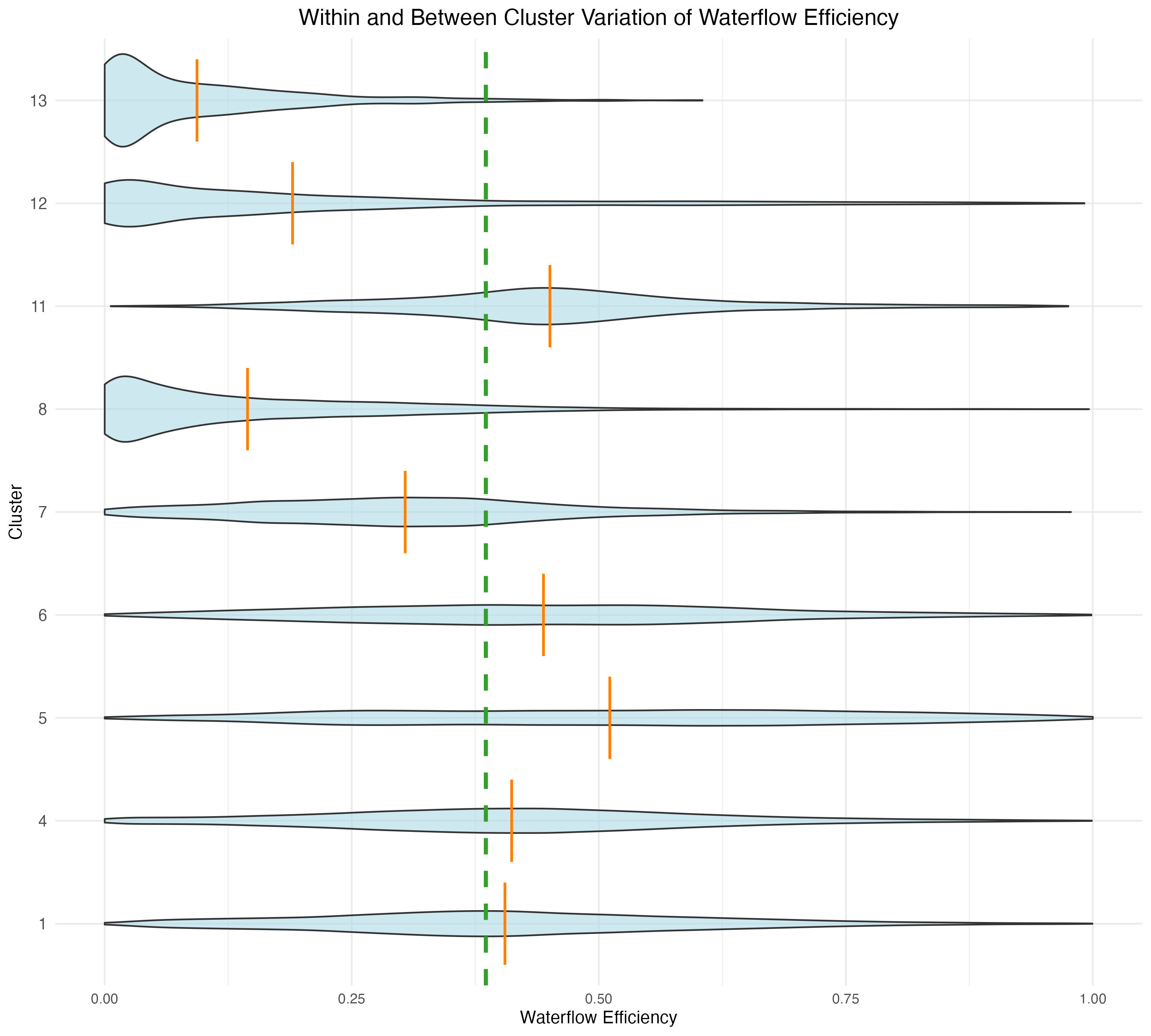
Build a stacked dataset of annual streamflow metrics (Qmean, Q05, Q95) and climate covariates, then disentangle shared vs. local drivers of hydrologic variability.
For every HYDAT watershed I assembled a 20-year panel that pairs gridded precipitation/temperature surfaces with gauge readings. Data QC flagged outliers, filled short gaps, and harmonized coordinate systems.
Fit Bayesian multilevel models (brms) for posterior distributions on slopes, then stress-tested with generalized additive models (mgcv) to capture residual nonlinearity.
Outputs inform water-resource agencies prioritizing storage upgrades and flow maintenance, while also serving as teaching material for multilevel modeling in environmental contexts.